Female Arousal Gel12 Ways to Read Female Arousal Gel Reviews and Spot the Unreliable Ones
12 Ways to Read Female Arousal Gel Reviews and Spot the Unreliable Ones
The short answer
Arousal gel reviews are a starting point, not proof. Read them for specific detail about ingredients, texture, timing and any irritation. Be wary of vague praise, repeated wording, reviews posted in bulk, and reviews from sellers. Reviews describe one person's experience. They cannot show that a product works for most people or is safe for everyone.
Some links on this site are affiliate links: if you buy through one, the site may earn a commission at no extra cost to you. More about this.
If you have spent time scrolling through star ratings and wondering which comments to trust, you are not alone. Most listings for over-the-counter arousal gels and serums have plenty of feedback, but not all of it is useful. Some accounts are detailed and honest. Others are short, generic and hard to check.
This guide covers 12 ways to read female arousal gel reviews and spot the unreliable ones. I chose these points because they are the patterns that come up again and again when you compare comments side by side. None of them need special training. They need a careful eye and a bit of patience.
Each point is practical. Some are about the wording of an account, some about the person who posted it, and some about what a comment can and cannot tell you. Use them together rather than relying on any single signal.
Let's dive in.
What reviews can and cannot tell you
| Review type | Useful for | Limitation |
|---|---|---|
| Specific detail | Real use and timing | Still one person's experience |
| Vague praise | Almost nothing | Hard to check or verify |
| Repeated wording | Spotting copied text | Not proof of dishonesty by itself |
| Three and four star | Balanced small downsides | Fewer examples overall |
| Burning or irritation reports | Flagging possible safety issues | Individual reactions vary |
| Sensation descriptions | Knowing what others felt | Subjective, not predictive for you |
A closer look at each
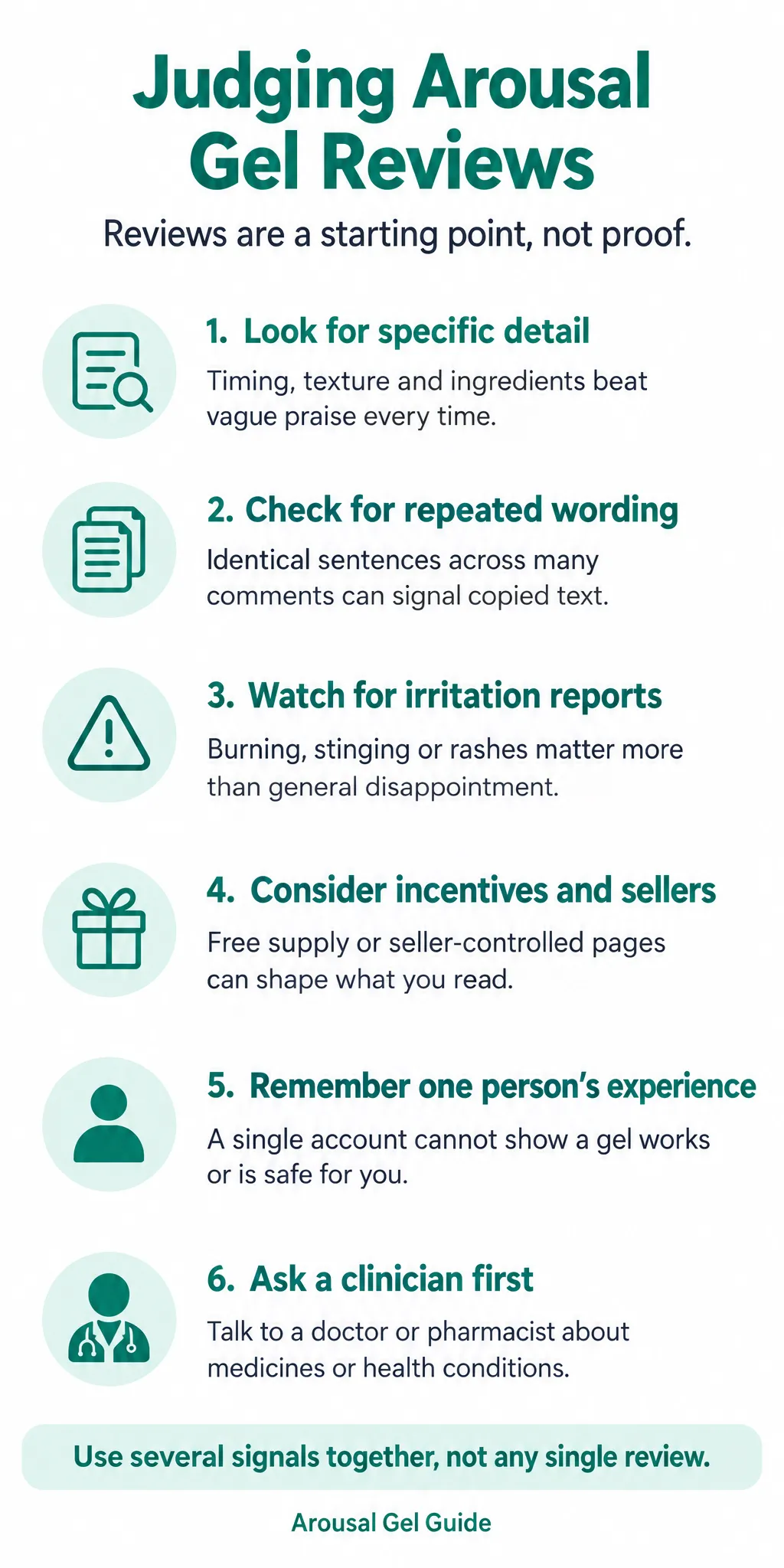
Look for specific detail: Specific accounts are harder to fake and more useful than general praise. A comment that says the gel took effect within a minute, or that it needed only a few drops, tells you something real. Vague lines like "amazing" say little about how the gel behaves on skin.
Check for repeated wording: Identical phrasing across many comments can signal copied or coordinated text. When several accounts share the same sentences or odd turns of phrase, I read that as a warning sign. Scroll through a few pages and see whether the wording varies the way real people's writing does.
Notice incentives and sponsorship: A person paid, gifted, or given a discount may be less neutral. Free supply does not make an account dishonest, but it does mean the writer had a reason to be positive. Look for a note saying the item was supplied for free, and weigh that account accordingly.
Watch for extreme ratings: Five-star and one-star accounts are the most likely to be emotional or unrepresentative. Someone who is delighted or furious often writes about the moment rather than the product. I find the three- and four-star accounts usually describe what the gel actually did, including its small downsides.
Separate feeling from evidence: Most accounts describe sensations, which are subjective. "Tingling," "warmth," and "more sensitive" are real experiences, but they vary from person to person. An honest account still may not predict how the gel will feel for you. Treat sensation reports as one data point, not proof.
Look for reports of burning or irritation: Safety-related complaints matter more than general dissatisfaction. A person who says a product disappointed them is less concerning than one who reports burning, stinging, or a rash. If several people mention irritation, take it seriously, check the ingredient list before you use it, and stop if you feel any pain.
Be careful with comparisons to prescription medicine: Some listings say a gel works like a prescription drug, and buyers repeat that in their comments. Repetition is not evidence. Someone saying a cream "works like Viagra" has not shown it contains the same active ingredient at a comparable dose. Check the ingredient list yourself, and be wary of any gel that names a prescription drug without listing that drug.
Consider the seller and the listing: A review on a page the seller controls may have been filtered, pinned, or chosen for display. Look at whether the feedback includes unflattering entries, whether it mentions the seller by name, and whether the same wording shows up across many entries. Feedback on a neutral site or a large marketplace usually gives a wider spread of opinions.
Compare sources: Different platforms attract different kinds of people. A product page on a large retailer such as Amazon.com may collect quick star ratings from one-time buyers, while a long video often comes from someone who tried the product over several sessions. I find it useful to read both and note where they agree and where they split.
Know what a review cannot prove: Readers often treat an account as proof of effectiveness or safety. A single person's report describes one body, one partner, and one set of circumstances. It cannot show that a product caused a result, and it cannot show that the product is safe for someone with a different health history. Treat these accounts as reports of experience, not as test results.
Use a quick checklist: A short routine helps you judge accounts the same way each time. Ask whether the writer describes a specific product and use, whether they mention a time frame such as how long the effect lasted, whether they give both good and bad points, and whether the claims are plausible. If an account fails most of these, I set it aside.
Talk to a clinician about health concerns: Reviews rarely address medications, pregnancy, or existing conditions, and someone else's experience will not tell you whether a product is right for you. If you take other medicines, are pregnant or trying to conceive, or have a condition affecting your health or sexual function, speak with a doctor or pharmacist before you use any gel.
What hands-on reviewers found
These are other people's hands-on tests, summarised and credited to them. Watch the full videos for their complete reviews.
Tawney Seren: Toy Review - Promescent Female Arousal Gel!
Tawney Seren found the Promescent female arousal gel fast acting and long lasting, with a light tingling and numbing effect, a mild minty taste, and no burning or freezing, and she credits it with extending her arousal and her partner's org
- The gel comes in a small black container that looks like a lipstick case, is discreet to carry, and has a very faint smell that does not stain lingerie. (at 0:33)
- The reviewer says only a few drops are needed, and a little goes a long way. (at 0:33)
- The reviewer says the gel acts fast and lasts up to 25 minutes, and she reached and kept arousal for about 25 minutes. (at 1:06)
Frequently asked questions
What arouses females the most?
No single answer fits everyone. For many women, arousal depends on comfort, feeling relaxed, emotional closeness, and attention to the areas they enjoy most. Stress, fatigue, and distraction can lower it. Many women find that slower, longer foreplay helps more than any one technique. Products like arousal gels are one possible aid, but they work alongside these basics rather than replacing them.
How long does arousal gel take to work?
It depends on the product. Some gels are described by users as acting within a few minutes, while others take longer. The accounts you read should say how soon the person applied it and in what situation. Read the product's own directions for timing, and do a test application on a small area first if you are unsure how your skin responds.
What can a female take to increase arousal?
Some women ask about supplements or medicines taken by mouth. Any ingestible product can interact with medications or existing conditions, and pregnancy changes what is safe. Talk with a doctor or pharmacist before taking anything new, especially if you take prescriptions. Non-prescription topical gels are a separate question, and the label and ingredient list are the place to start.
Are female arousal gel reviews reliable?
Accounts can give useful clues about texture, scent, and how fast a gel seems to act, but they cannot prove it works for you. Look for writers who describe their own use in specific terms, and be cautious about feedback that is all five stars, nearly identical, or that mainly repeats marketing language. Each account is one person's experience, not a test.
Can arousal gel cause irritation or burning?
Some people report burning, stinging, or irritation with arousal gels, and this is one reason to read feedback closely. Check the ingredient list for anything you know you react to. Patch test on a small area of skin first, and stop using the gel if you notice burning, itching, or discomfort. A clinician can help if irritation continues or you have a history of sensitive skin.